SVBONY SC571CC Astronomy Camera Review: Best-Selling Cooled APS-C Camera Worth It?
Quick Overview
The SVBONY SC571CC is a dedicated APS-C color cooled astronomy camera built around a Sony IMX571 BSI sensor, aimed at deep-sky imagers who want low noise and stable long-exposure performance without the price tag of full-frame cooled cameras. With a two-stage TEC cooler that can pull the sensor up to 35 degrees Celsius below ambient temperature, a 16-bit ADC, and a 512MB DDR3 buffer, it is designed to hold detail in faint nebulae and galaxies across long imaging sessions. You can check current availability and pricing directly through SVBONY’s official site.
Key Features
The SC571CC is built around the Sony IMX571 APS-C format BSI (back-illuminated) sensor, which SVBONY rates at over 80% peak quantum efficiency, meaning it captures a larger share of incoming photons than older front-illuminated sensors of similar size. That efficiency matters most on faint targets where every photon counts.
Cooling is handled by a two-stage thermoelectric (TEC) module capable of dropping sensor temperature up to 35 degrees Celsius below the surrounding air. Deep cooling like this suppresses thermal noise, which is what usually limits exposure length on an uncooled camera, so subs stay cleaner even at 3-5 minutes or longer.
SVBONY also highlights zero amp-glow on this sensor, a common defect on some CMOS astro cameras where the amplifier circuitry introduces a visible glow in the corners of long exposures. Combined with the 16-bit ADC (versus 12-bit on many entry cameras), the SC571CC captures a wider dynamic range, useful for recovering detail in both bright stars and dim nebulosity in the same frame.
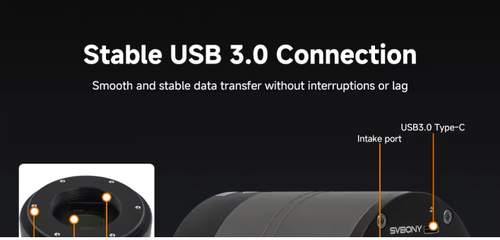
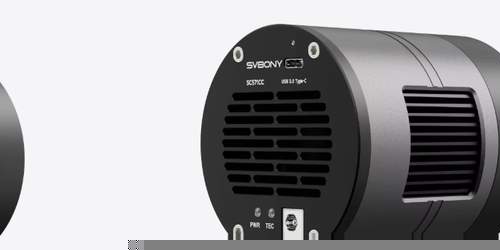
A 512MB DDR3 memory buffer sits between the sensor and the USB output, smoothing data transfer during high frame-rate capture or long exposure sequences. Physically, the camera has a compact 90mm body, an M42x0.75 thread mount for compatibility with common astrophotography adapters and filter wheels, and runs on a simple 12V/3A power connection alongside USB 3.0 Type-C for image download.
Who It’s For
This camera is best suited to intermediate and advanced astrophotographers who already have a telescope or fast astrograph and want to move from a DSLR or uncooled camera into dedicated deep-sky imaging. The APS-C sensor size gives a wider field of view than smaller 1-inch sensors, which pairs well with shorter focal length refractors for framing large nebulae and galaxy fields.
Because of the M42x0.75 mount and standard USB 3.0/12V power requirements, it also fits naturally into most existing astrophotography rigs that already use filter wheels, off-axis guiders, or automated capture software, rather than requiring a from-scratch setup.

Pricing
At the time of writing, the SC571CC is listed on the official SVBONY store at $1,299.99, with a comparison reference price shown at $1,333.99. Pricing on cooled astronomy cameras can shift with promotions, so it’s worth checking the current listing on SVBONY’s site for the latest number before ordering.
For context, dedicated cooled APS-C cameras from other brands in this sensor class often run noticeably higher, so the SC571CC positions itself as a comparatively accessible entry point into cooled deep-sky imaging with a full-size APS-C sensor.
Pros and Cons
Pros: Sony IMX571 APS-C BSI sensor with over 80% quantum efficiency; two-stage TEC cooling down to 35°C below ambient; 16-bit ADC for wide dynamic range; zero amp-glow; 512MB DDR3 buffer for smooth data flow; standard M42x0.75 mount and USB 3.0 Type-C connectivity that fits existing astro rigs.
Cons: At roughly $1,300, it’s a serious investment aimed at intermediate-to-advanced users rather than beginners; a cooled camera also requires a stable 12V power source and typically benefits from a laptop or mini-PC for control, adding to the overall setup cost.
FAQ
What sensor does the SC571CC use?
It uses the Sony IMX571, an APS-C format back-illuminated (BSI) CMOS sensor known for high quantum efficiency and low read noise, popular in dedicated cooled astronomy cameras.
How cold can the cooler get?
The two-stage TEC cooling system can bring the sensor down to approximately 35°C below ambient temperature, which significantly reduces thermal noise during long exposures.
What mount and connections does it use?
It uses a standard M42x0.75 thread mount, connects via USB 3.0 Type-C for data, and requires a 12V/3A power source for the cooling system.
Is this camera beginner-friendly?
It’s better suited to imagers who already have some experience with a telescope and capture software, since getting the most from a cooled camera involves managing cooling, guiding, and calibration frames.
Bottom Line
The SVBONY SC571CC brings a genuinely capable APS-C cooled sensor, strong dynamic range, and amp-glow-free long exposures into a package that’s more attainable than many rivals in the same sensor class. For anyone ready to step up from an uncooled camera or DSLR into serious deep-sky imaging, it’s worth a close look — you can see full specs and current pricing at SVBONY’s official site.