
Proxy-Cheap Residential Proxies Review: Worth It?
Anyone who’s tried to scrape data, manage multiple social accounts, or check ad placements from another country has run into IP blocks fast. Proxy-Cheap built its residential proxy service specifically around that problem, offering access to a 50M+ IP pool starting at under a dollar per GB at higher volumes. We looked at how the service actually works, what it costs, and who it makes sense for before recommending it.
What It Actually Is
Proxy-Cheap’s residential proxies route a user’s traffic through real IP addresses assigned by internet service providers to actual residential devices, rather than datacenter IPs that are easier for websites to detect and block. According to Proxy-Cheap’s own service page, each IP in their pool of 50M+ addresses is tied to a genuine physical location, which is what makes the traffic indistinguishable from a normal home user rather than an obvious proxy. The service supports both rotating IPs, which change automatically at set intervals to maximize anonymity, and sticky sessions, which hold the same IP for a fixed period when a task needs a stable connection.
Key Features
The service covers the basics that matter for proxy reliability: unlimited concurrent threads with minimal performance drop, user/password authentication, and support for both HTTP and SOCKS5 protocols so it can handle browsing, scraping, gaming, or file transfers rather than just simple web requests. Geo-targeting is a core feature — Proxy-Cheap lists proxy locations across the United States, United Kingdom, Singapore, Brazil, Germany, Turkey, Australia, Pakistan, India, Thailand, Canada, and more, with an option to request additional locations that aren’t already covered.

Who This Is For
This is aimed at people and businesses running location-sensitive or high-volume online tasks: social media managers handling multiple accounts without tripping IP bans, data scraping and market research teams, e-commerce sellers doing price and listing checks across regions, ad verification professionals confirming how campaigns render by location, and SEO practitioners doing rank tracking or competitive research from specific geographies. It’s not really built for someone who just wants basic privacy browsing — for that, a VPN (which encrypts and routes all device traffic) is the more appropriate tool, since Proxy-Cheap’s residential proxies only route specific application or browser traffic rather than encrypting everything.
Pricing
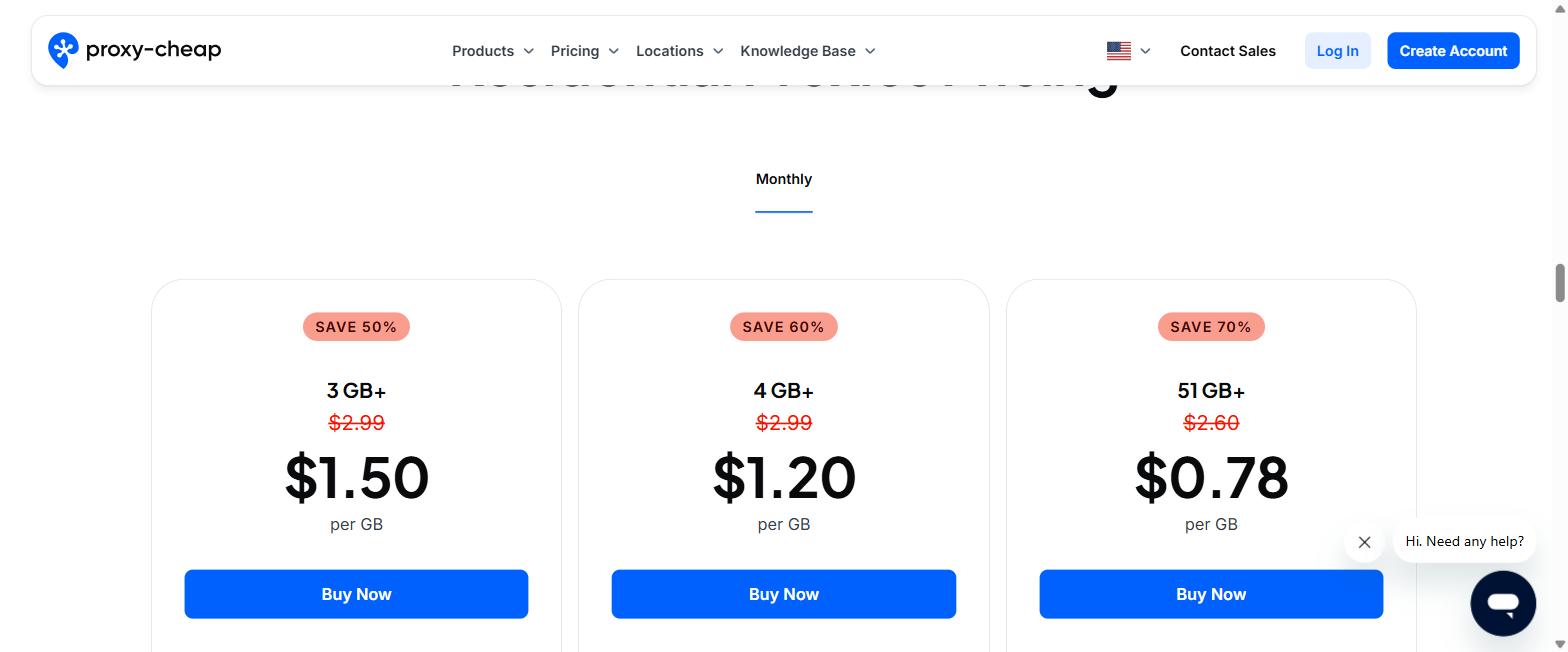
Residential proxy pricing on Proxy-Cheap is usage-based and scales down as volume goes up: the 3GB+ monthly tier runs $1.50 per GB (50% off the $2.99 base rate), the 4GB+ tier drops to $1.20 per GB (60% off), and the 51GB+ tier falls to $0.78 per GB (70% off the $2.60 base rate). Every tier includes user/password authentication, unlimited threads, and both sticky and rotating session options, so the pricing difference is purely about volume rather than feature gating. There are no setup costs, and plans can be canceled anytime.
Pros and Cons
Pros: large 50M+ residential IP pool across a wide range of countries, genuinely usage-based pricing that gets cheaper at scale rather than locking features behind higher tiers, unlimited concurrent threads, both SOCKS5 and HTTP support, no setup fees and cancel-anytime terms, 24/7 customer support.
Cons: entry-level per-GB pricing ($2.99) is higher than some competitors before volume discounts kick in, residential proxies are inherently more complex to set up than a basic VPN for someone who just wants simple privacy, and heavy data-intensive use cases (large-scale scraping) can get expensive quickly at the per-GB model before hitting the higher-volume discount tiers.
Frequently Asked Questions
What are residential proxies?
Proxy services that use IP addresses assigned to real residential locations by ISPs, rather than datacenter IPs — this makes traffic look like it’s coming from an ordinary home user, which is harder for websites to detect and block.
How much do Proxy-Cheap’s residential proxies cost?
Pricing starts at $2.99 per GB and drops with volume — $1.50/GB at 3GB+, $1.20/GB at 4GB+, and $0.78/GB at 51GB+, according to the current pricing listed on Proxy-Cheap.
What’s the difference between a proxy and a VPN?
A proxy routes traffic only from a specific browser or application, while a VPN encrypts and routes all traffic from the entire device — VPNs offer broader privacy and encryption, while proxies offer more targeted, task-specific control.
Can I use SOCKS5 with Proxy-Cheap’s residential proxies?
Yes — the service supports SOCKS5 in addition to HTTP, which makes it usable for tasks like gaming, streaming, and file transfers, not just standard web browsing.
Bottom Line
Proxy-Cheap’s residential proxy service delivers on the fundamentals that matter for this category: a genuinely large IP pool, real geo-targeting across a wide list of countries, unlimited threads, and pricing that actually improves with volume instead of gating features behind higher tiers. It’s not the right tool for basic device-wide privacy — that’s a VPN’s job — but for scraping, account management, ad verification, or market research where location-specific, application-level traffic matters, it’s a solid, no-frills option worth trying through Proxy-Cheap’s site.